One Day the Flames Will Die Out
The Beautiful Truth of Full Metal Jacket
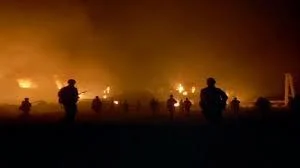
The city of Huế is burning. The flames that light up the night whisper softly to each other. They speak of the events of the past day that have painted the ground with red. They burn out of every broken window, every open doorway and every other hole brought about by bullets and bombshells. Huế barely resembles a city anymore. The streets are filled with debris and dead bodies, the buildings look as if they were torn apart by mythological beasts. And in the midst of the destruction march the shadows of soldiers, their rifles firmly in their hands. Their gaze is fixed on the horizon and their step is filled with conviction. They do not look back, not even to their side. Meanwhile the flames gaze down on them, dancing ferociously in the wind, but the soldiers are not bothered by their judgment. Their footsteps form the rhythm to a sinister symphony, the coda to an act of an endless play. All they can do is head for the river and live for another night.
The final scene of Full Metal Jacket can be described with many words. It is haunting, depressing and moving, but it is also magical, profound and beautiful. Of course, Kubrick knows how to craft a shot. The depth in his cinematography is breathtaking; the night sky in the background, lit up by flames almost as tall as the buildings whose clutches they attempt to elude; the silhouettes of soldiers both close and far away. Kubrick’s eye for composition is one of the finest in the history of film, yet there is something more to the scene, something below the surface. Despite the destruction and the death, the soldiers who march through the rubble do not seem defeated. They hold their spirits high through song and brotherhood. Their valiant voices pierce through the darkness and leave a faint trail of humanity in an otherwise apocalyptic wasteland. They are not who they once were. We saw them lose their hair in the first scene of the film, stripped from their boyhood and thrusted into torment. They no longer have names, but are pawns on a chessboard. As the soldiers march through the flames, we see only their shadow. They are indistinguishable. Expendable. The only thing separating them from their brothers in the dirt is a bullet and some time. And yet they march on, their faces pointing in the same direction, their voices singing the same song.
Who’s the leader of the club that’s made for you and me? M-I-C-K-E-Y-M-O-U-S-E Hey there. Hi there. Ho there. You’re as welcome as can be. M-I-C-K-E-Y-M-O-U-S-E
The lyrics of the army chant stand in stark contrast with their context. The thought of colorful Disney characters is about the last thing one might associate with the devastation in Huế. There appears to be no place for delight and solace in the dystopia composed by Kubrick, where death awaits around the next corner and hope seems but a castle in the sky. And yet, Kubrick chooses to leave his viewers with a taste of silliness, a ray of sunshine on a gloomy winter day. Kubrick reminds us that even though these shadows are cogs in a machine, trained killers in a bloody war, they are also still boys. Only a few years ago, they watched cartoons on the television as their mother made them dinner. Now they stand on the doorstep of hell.
I am in a world of shit.. yes. But I am alive. And I am not afraid.
The voice-over that accompanies the final scene of the film points directly at its core. Even in our darkest hour, there is beauty to be found. One might argue that the beauty of Full Metal Jacket’s final scene lies in the promise of new beginnings, that the destruction is beautiful because it disposes of the old and makes place for the new. Yet one does not get the sense that any life will ever regrow out of the ashes of Huế. The fires are still raging, the buildings are still crumbling. The wound is still fresh. Instead, the beauty in the scene is a human beauty. It touches on the core of the human condition and speaks to our deepest contradictions. Full Metal Jacket is not about rebirth. It is about perseverance.
Come along and sing a song and join the jamboree M-I-C-K-E-Y-M-O-U-S-E Here we go a-marching and a-shouting merrily M-I-C-K-E-Y-M-O-U-S-E
The final images of the film comment on the duality of man. Our desire to live goes hand in hand with our need to kill and destroy. Kubrick could have chosen to wallow in the comfort of despair, to reaffirm the collective sentiment that war is unequivocally evil. And while he certainly makes this argument throughout the film, Kubrick also recognises that it is not the whole truth. Yes, war is a product of our darkest dispositions, but it also shines a light on what makes us inherently human. It takes away all of our pretences and strips us down to our most primal form, for better or for worse. We as the viewer do not hold the soldiers in contempt, nor do we put them on a pedestal, for we know that the beautiful truth of Full Metal Jacket applies to every single one of us.
The city of Huế is burning. The flames have ended their conversation, but murmur softly to themselves. The chants of the soldiers grow ever fainter, carried by a gentle wind making its way through the brick and metal carcasses. Slowly their voices die out, until a silence falls over the city. The moment has passed. The fleeting beauty of the chanting soldiers has evaporated and left only the death and the destruction. One day the flames will die out. One day the rubble will be removed and the buildings rebuilt. The bodies will be buried and the dead will be remembered. Until that day, the soldiers will march forward, without looking back. Like pawns on a chess board.